.. note:: To download the tutorial data, use the following commands:
All tutorial data:
from recon.data import fetch_all_tutorial_data
fetch_all_tutorial_data(data_dir='./data')
Specific file (e.g., RNA data):
from recon.data import fetch_tutorial_data
fetch_tutorial_data('perturbation_tuto/rna.h5ad', data_dir='./data')
Predicting Treatment Effects with ReCoN
This tutorial demonstrates how to use ReCoN to predict the cell-type-specific effects of a molecular treatment. You will learn how to:
Build a multilayer network integrating GRNs and cell-cell communication
Select a molecule (ligand) to perturb
Predict direct effects (on receptor-expressing cells) and indirect effects (via cell-cell signaling)
Compare predicted responses across cell types
Use case: Given a therapeutic molecule (e.g., a ligand or antibody), predict which genes will be affected in each cell type and identify cell-type-specific responses.
import numpy as np
import scanpy as sc  # single cell data
import pandas as pd  # data manipulation
import liana as li  # cell communication
import recon  # multilayer and perturbation prediction
import recon.data
OMP: Info #276: omp_set_nested routine deprecated, please use omp_set_max_active_levels instead.
Setup
ReCoN uses single-cell RNA-seq data to infer cell-cell communication and gene regulatory networks.
Tip
The example data for this tutorial can be downloaded from the ReCoN repository.
Note
Required packages
This tutorial requires liana for cell-cell communication inference:
Install with:
pip install liana
rna = sc.read_h5ad("./data/perturbation_tuto/rna.h5ad")
Let’s check what cell types are present in this dataset
rna.obs["celltype"].unique().tolist()[:5]
['B_cell', 'ILC', 'Macrophage', 'MigDC', 'Monocyte']
Build the Multilayer Network
ReCoN integrates three main components:
Gene Regulatory Networks (GRNs) - TF → target gene relationships
Cell-Cell Communication (CCC) - Ligand-receptor interactions between cell types
Receptor-Gene Links - How receptors connect to intracellular signaling
1. Import Gene Regulatory Network
You can either generate GRNs directly with ReCoN or import a previously generated one.
Tip
If you wish to generate GRNs directly with ReCoN, please follow Tutorial 4: GRN Inference with HuMMuS.
Warning
GRN inference requires a Python 3.10 conda environment due to CellOracle dependencies. See the Installation guide for details.
grn_path = "./data/perturbation_tuto/grn.csv"
grn = pd.read_csv(grn_path)
grn = grn.sort_values(by="weight", ascending=False)[:500_000]
grn["source"] = grn["source"].str.capitalize()
grn["source"] = grn["source"] + '_TF'
grn["target"] = grn["target"].str.capitalize()
grn.head(3)
| Unnamed: 0 | target | source | weight | |
|---|---|---|---|---|
| 0 | 0 | Pax5 | Mbd1_TF | 0.000095 |
| 2 | 2 | Pax5 | Smad5_TF | 0.000092 |
| 1 | 1 | Pax5 | Smad1_TF | 0.000092 |
2. Compute Cell-Cell Communication
The cell-cell communication is inferred through LIANA+, an external package dedicated to this task.
Tip
For more information, check the LIANA+ documentation.
li.method.cellphonedb(rna,
            # NOTE by default the resource uses HUMAN gene symbols
            resource_name="mouseconsensus",
            expr_prop=0.00,
            use_raw=False,
            groupby="celltype",
            verbose=True, key_added='cpdb_res')
Using resource `mouseconsensus`.
Using `.X`!
/pasteur/appa/homes/rtrimbou/miniconda3/envs/snakemake/envs/recon-grn/lib/python3.10/site-packages/anndata/_core/anndata.py:430: FutureWarning: The dtype argument is deprecated and will be removed in late 2024.
15364 features of mat are empty, they will be removed.
Make sure that normalized counts are passed!
/pasteur/appa/homes/rtrimbou/miniconda3/envs/snakemake/envs/recon-grn/lib/python3.10/site-packages/liana/method/_pipe_utils/_pre.py:146: ImplicitModificationWarning: Trying to modify attribute `.obs` of view, initializing view as actual.
/pasteur/appa/homes/rtrimbou/miniconda3/envs/snakemake/envs/recon-grn/lib/python3.10/site-packages/liana/method/_pipe_utils/_pre.py:149: FutureWarning: The default of observed=False is deprecated and will be changed to True in a future version of pandas. Pass observed=False to retain current behavior or observed=True to adopt the future default and silence this warning.
0.36 of entities in the resource are missing from the data.
Generating ligand-receptor stats for 1296 samples and 937 features
100%|██████████| 1000/1000 [00:04<00:00, 216.62it/s]
Format the LIANA output for ReCoN (rename columns to standard format):
Note
Required column names for ReCoN:
source: ligand nametarget: receptor namecelltype_source: cell type producing the ligandcelltype_target: cell type expressing the receptorweight: interaction score (e.g., lr_means)
ccc_network = rna.uns["cpdb_res"].copy()
ccc_network = ccc_network[["ligand", "receptor", "lr_means", "source", "target"]]
ccc_network = ccc_network.rename(columns={
    "lr_means": "weight",
    "source": "celltype_source",
    "target": "celltype_target",
    "ligand": "source",
    "receptor": "target"
})
ccc_network = ccc_network[ccc_network['weight'] != 0]
ccc_network.head(3)
| source | target | weight | celltype_source | celltype_target | |
|---|---|---|---|---|---|
| 406685 | App | Cd74 | 102.485008 | cDC2 | cDC1 |
| 405645 | Copa | Cd74 | 102.370003 | cDC1 | cDC1 |
| 410237 | Copa | Cd74 | 102.366211 | eTAC | cDC1 |
3. Load Receptor-Gene Links
These links connect membrane receptors to downstream target genes in the GRN, enabling signal propagation from extracellular to intracellular networks.
receptor_genes = recon.data.load_receptor_genes("mouse_receptor_gene_from_NichenetPKN")
# for human, use "human_receptor_gene_from_NichenetPKN"

genes = np.unique(grn['source'].tolist() + grn['target'].tolist())
receptor_genes = receptor_genes[receptor_genes['target'].isin(genes)]
receptor_genes.head()
| source | target | weight | |
|---|---|---|---|
| 2 | A1bg | Abca1 | 0.005156 |
| 3 | A1bg | Abcb1a | 0.005877 |
| 4 | A1bg | Abcb1b | 0.005877 |
| 7 | A1bg | Acsl1 | 0.005915 |
| 8 | A1bg | Adk | 0.005092 |
Select a Molecule to Perturb
For treatment effect prediction, we need to choose a molecule (ligand) to simulate as a treatment. There are several strategies:
Strategy 1: Choose a receptor with high variance across cell types, then find its ligands.
This helps identify molecules that may have cell-type-specific effects:
# variance
ccc_network.groupby("target")["weight"].var().sort_values(ascending=False).head(3)
target
Cd74     932.779297
Cd68     155.465271
Itgal    152.500290
Name: weight, dtype: float32
Now identify the natural ligands of this receptor. You can either:
Use a designed molecule targeting this receptor
Choose one of its natural ligands from the cell communication network
ligands = ccc_network[ccc_network["target"]=="Cd74"]['source'].unique().tolist()
ligands
['App', 'Copa']
Run Treatment Effect Prediction
The multicell_targets function builds the multilayer network and runs Random Walk with Restart to predict treatment effects.
Note
Direct vs Indirect Effects
Direct effect: Impact on cells that directly express the receptor for your molecule
Indirect effect: Impact propagated through cell-cell communication from directly affected cells to other cell types
%%time
direct_effect, indirect_effect = recon.explore.multicell_targets(
        seeds=["Copa"],
        celltypes=["B_cell", "pDC", "Macrophage", "NK_cell", "T_cell_CD4", "T_cell_CD8"],
        grn=grn,
        receptor_grn=receptor_genes,
        ccc=ccc_network,
        grn_graph_weighted=True,
        receptor_grn_graph_weighted=True,
        receptor_graph_weighted=False,
        cell_communication_graph_weighted=True,
        cell_communication_graph_directed=False,
        restart_proba=0.6,
        extend_seeds=True,
        njobs=15
    )
Processing celltype 1/6: B_cell
Processing celltype 2/6: pDC
/pasteur/helix/projects/ml4ig_hot/Users/rtrimbou/ReCoN/src/recon/explore/recon.py:122: UserWarning:
                No receptor_graph provided,
                an empty receptor graph will be created.
Processing celltype 3/6: Macrophage
Processing celltype 4/6: NK_cell
Processing celltype 5/6: T_cell_CD4
Processing celltype 6/6: T_cell_CD8
/pasteur/helix/projects/ml4ig_hot/Users/rtrimbou/ReCoN/src/recon/explore/recon.py:387: UserWarning: The celltypes dictionary was converted toa list of Celltype objects.
The keys of the dictionary will be the celltype names.
Computing intracellular contributions and direct effect...
Computing intercellular contributions and indirect effect...
  0%|          | 0/6 [00:00<?, ?it/s][Parallel(n_jobs=6)]: Using backend LokyBackend with 6 concurrent workers.
100%|██████████| 6/6 [00:00<00:00, 31.15it/s]
[Parallel(n_jobs=6)]: Done   2 out of   6 | elapsed:  1.1min remaining:  2.3min
[Parallel(n_jobs=6)]: Done   3 out of   6 | elapsed:  1.1min remaining:  1.1min
[Parallel(n_jobs=6)]: Done   4 out of   6 | elapsed:  1.2min remaining:   35.0s
[Parallel(n_jobs=6)]: Done   6 out of   6 | elapsed:  1.3min finished
CPU times: user 1min 2s, sys: 5.93 s, total: 1min 8s
Wall time: 2min 11s
Analyze Treatment Effects
View Direct and Indirect Effects
Direct effects: Genes affected in cells expressing the target receptor
direct_effect.head()
| celltype_target | B_cell | pDC | Macrophage | NK_cell | T_cell_CD4 | T_cell_CD8 |
|---|---|---|---|---|---|---|
| gene | ||||||
| Zzz3 | 5.568139e-09 | 9.124538e-09 | 6.006453e-09 | 1.443905e-09 | 1.465908e-09 | 1.560960e-09 |
| Zzef1 | 7.910818e-09 | 1.276460e-08 | 8.532004e-09 | 2.241151e-09 | 2.276372e-09 | 2.427962e-09 |
| Zyx | 2.311808e-08 | 2.538018e-08 | 2.369134e-08 | 2.052888e-08 | 2.055242e-08 | 2.059275e-08 |
| Zyg11b | 1.309827e-09 | 2.150962e-09 | 1.419632e-09 | 3.216471e-10 | 3.280418e-10 | 3.516321e-10 |
| Zxdc | 1.692286e-09 | 2.749142e-09 | 1.834584e-09 | 4.614275e-10 | 4.729096e-10 | 5.125789e-10 |
indirect_effect.head()
| celltype_target | B_cell | pDC | ... | T_cell_CD4 | T_cell_CD8 | ||||||||||||||||
|---|---|---|---|---|---|---|---|---|---|---|---|---|---|---|---|---|---|---|---|---|---|
| celltype_source | B_cell | pDC | Macrophage | NK_cell | T_cell_CD4 | T_cell_CD8 | B_cell | pDC | Macrophage | NK_cell | ... | Macrophage | NK_cell | T_cell_CD4 | T_cell_CD8 | B_cell | pDC | Macrophage | NK_cell | T_cell_CD4 | T_cell_CD8 |
| gene | |||||||||||||||||||||
| Zzz3 | 7.760396e-13 | 1.363160e-14 | 1.044374e-14 | 3.864495e-15 | 3.308231e-15 | 3.894846e-15 | 1.189547e-14 | 1.292471e-12 | 1.741090e-14 | 7.543820e-15 | ... | 1.090120e-14 | 5.014306e-15 | 3.703540e-13 | 5.171489e-15 | 9.401747e-15 | 1.659415e-14 | 1.279711e-14 | 5.898745e-15 | 5.182911e-15 | 4.402922e-13 |
| Zzef1 | 1.032097e-12 | 2.167997e-14 | 1.462936e-14 | 4.876303e-15 | 3.561045e-15 | 4.477299e-15 | 1.598278e-14 | 1.844777e-12 | 2.322816e-14 | 9.321181e-15 | ... | 1.410505e-14 | 5.392201e-15 | 4.702954e-13 | 5.585412e-15 | 1.191117e-14 | 2.415251e-14 | 1.715160e-14 | 6.699112e-15 | 5.532836e-15 | 5.562709e-13 |
| Zyx | 1.618271e-12 | 2.585074e-14 | 2.084081e-14 | 1.099187e-14 | 8.041645e-15 | 1.364838e-14 | 4.492823e-14 | 3.131443e-12 | 7.201589e-14 | 3.947233e-14 | ... | 2.039161e-14 | 1.069780e-14 | 6.427157e-13 | 1.092050e-14 | 1.666707e-14 | 2.710333e-14 | 2.115135e-14 | 1.055248e-14 | 8.195229e-15 | 1.014019e-12 |
| Zyg11b | 5.348643e-13 | 7.700479e-15 | 6.028346e-15 | 2.836186e-15 | 2.123397e-15 | 2.913058e-15 | 6.033199e-15 | 7.885257e-13 | 7.826252e-15 | 3.810466e-15 | ... | 3.306024e-15 | 1.499960e-15 | 2.344538e-13 | 1.989635e-15 | 5.479759e-15 | 8.888517e-15 | 6.859509e-15 | 3.435869e-15 | 2.977849e-15 | 4.643857e-13 |
| Zxdc | 3.455731e-13 | 4.689825e-15 | 3.212930e-15 | 1.931706e-15 | 1.274738e-15 | 1.452460e-15 | 5.061063e-15 | 1.132353e-12 | 1.440172e-14 | 3.223035e-15 | ... | 4.276130e-15 | 1.979657e-15 | 2.148038e-13 | 2.091834e-15 | 3.257674e-15 | 5.661517e-15 | 4.910019e-15 | 2.249046e-15 | 2.049784e-15 | 2.335122e-13 |
5 rows × 36 columns
Indirect effects: Genes affected through cell-cell communication cascades
total_effect = recon.explore.combine_effects(direct_effect, indirect_effect, alpha=0.8)
total_effect.head()
| celltype_target | B_cell | pDC | Macrophage | NK_cell | T_cell_CD4 | T_cell_CD8 |
|---|---|---|---|---|---|---|
| gene | ||||||
| Zzz3 | 0.000036 | 0.000030 | 0.000032 | 0.000036 | 0.000037 | 0.000036 |
| Zzef1 | 0.000048 | 0.000043 | 0.000044 | 0.000051 | 0.000049 | 0.000047 |
| Zyx | 0.000085 | 0.000078 | 0.000071 | 0.000125 | 0.000129 | 0.000138 |
| Zyg11b | 0.000022 | 0.000017 | 0.000017 | 0.000028 | 0.000020 | 0.000032 |
| Zxdc | 0.000015 | 0.000023 | 0.000022 | 0.000021 | 0.000020 | 0.000018 |
Combine Direct and Indirect Effects
The combine_effects function merges direct and indirect effects using a weighting parameter α:
$$\text{Total Effect} = \alpha \times \text{Direct} + (1 - \alpha) \times \text{Indirect}$$
Tip
The default α = 0.8 gives more weight to direct effects, which has been empirically validated. You can adjust this based on your biological question.
%matplotlib inline
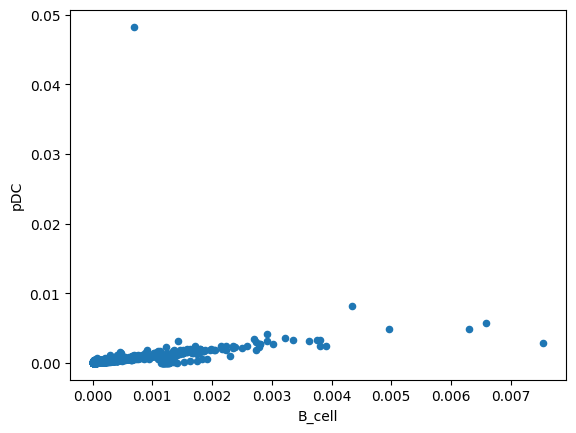
total_effect.plot.scatter(x='B_cell', y='pDC')
<Axes: xlabel='B_cell', ylabel='pDC'>
Visualize Cell Type Correlations
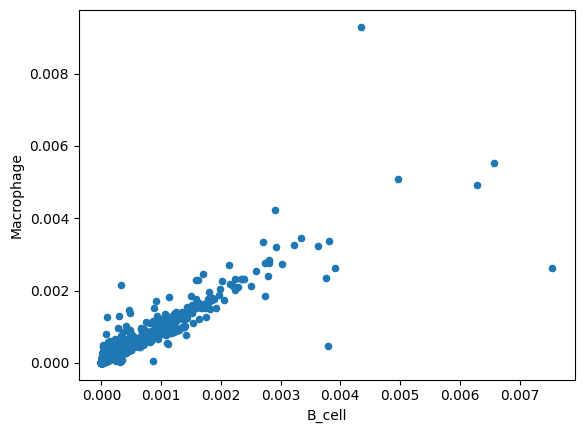
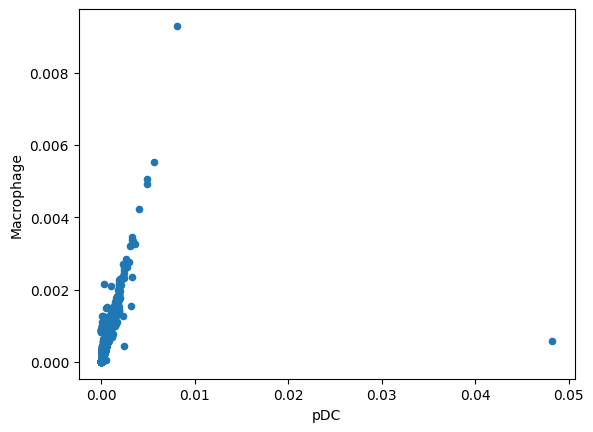
Scatter plots showing correlation of predicted effects between cell types:
%matplotlib inline
total_effect.plot.scatter(x='B_cell', y='Macrophage')
<Axes: xlabel='B_cell', ylabel='Macrophage'>
%matplotlib inline
total_effect.plot.scatter(x='pDC', y='Macrophage')
<Axes: xlabel='pDC', ylabel='Macrophage'>
Compare Cell-Type-Specific Responses
A key application of ReCoN is identifying differential responses between cell types. This helps understand:
Which cell types are most affected by a treatment
Which genes drive cell-type-specific responses
Potential off-target effects on non-target cell populations
T cells CD4+ vs B cells
Compare predicted treatment response between T helper cells and B cells:
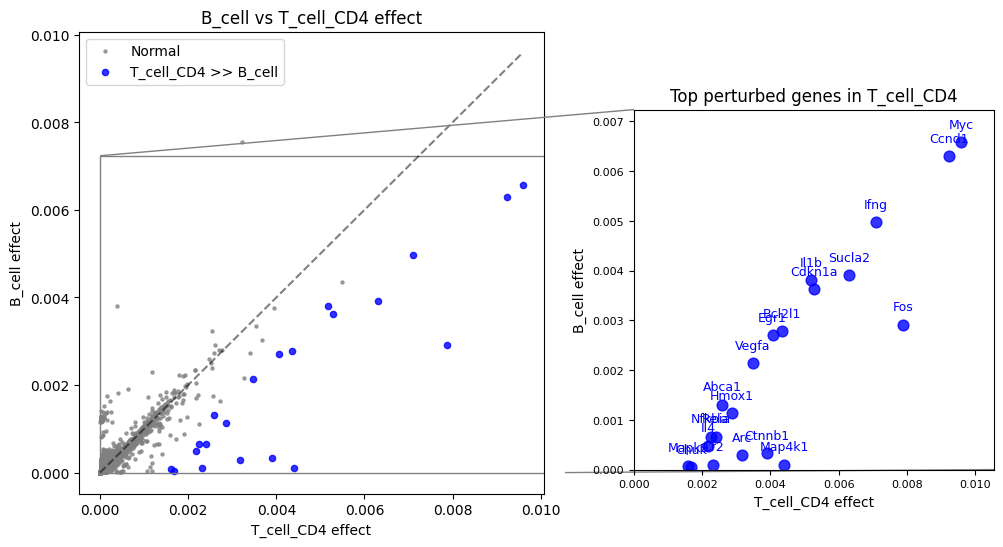
(total_effect["T_cell_CD4"] - total_effect["B_cell"]).sort_values(ascending=False)[:20]
gene
Fos       0.004969
Map4k1    0.004299
Ctnnb1    0.003570
Myc       0.003014
Ccnd1     0.002946
Arc       0.002888
Sucla2    0.002392
Cr2       0.002220
Ifng      0.002124
Rela      0.001742
Hmox1     0.001735
Il4       0.001699
Cdkn1a    0.001655
Chuk      0.001628
Nfkbia    0.001590
Bcl2l1    0.001563
Mapk9     0.001519
Il1b      0.001379
Egr1      0.001368
Vegfa     0.001333
dtype: float64
Note
Biological interpretation
Genes with higher scores in T cells CD4+ include known markers like Cd40lg, Cxcr4, and Cxcr6 - confirming that ReCoN captures biologically meaningful cell-type-specific signatures.
Visualize with a comparison plot highlighting the most differential genes:
recon.plot.plot_celltype_comparison(total_effect, "T_cell_CD4", "B_cell", quantile=0.998)
B cells vs T cells CD4+
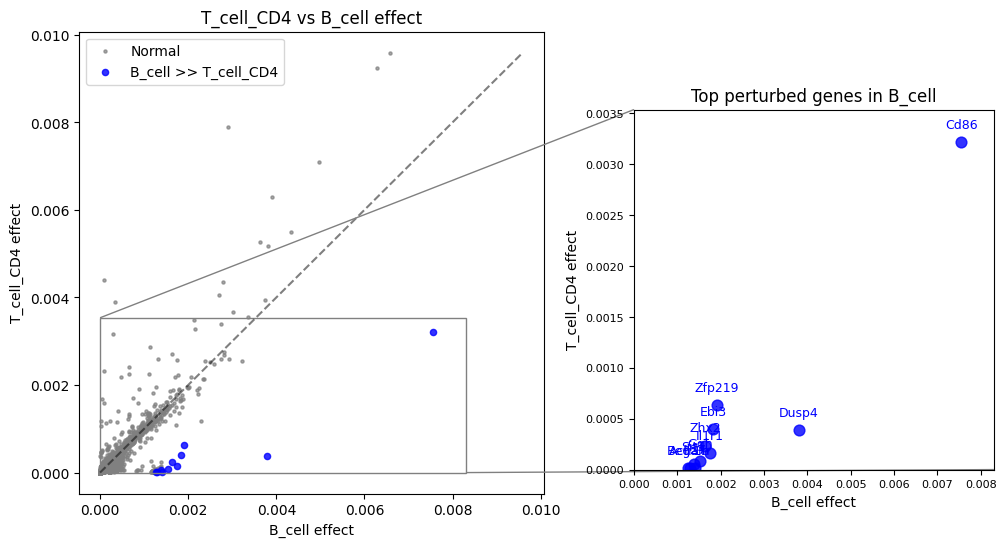
Now look at genes with higher scores in B cells:
(total_effect["B_cell"] - total_effect["T_cell_CD4"]).sort_values(ascending=False)[:20]
gene
Cd86        0.004334
Dusp4       0.003410
Il1r1       0.001595
Ggh         0.001451
Ebi3        0.001430
Zhx2        0.001403
Il27        0.001391
Sit1        0.001321
Zfp219      0.001284
Actr1b      0.001268
Begain      0.001242
Smpd3       0.001242
Slc25a44    0.001241
Aptx        0.001230
Lipc        0.001223
Asb1        0.001221
Epcam       0.001220
Pmvk        0.001212
Mplkip      0.001203
Tdgf1       0.001192
dtype: float64
Note
Biological interpretation
Genes with higher expression in B cells include:
Cd86: Marker of antigen presenting cells (including B cells)
Ccr6: Classical marker of B cells, important for germinal center formation
References:
Suan D et al. (2017) Immunity 47(6):1142-1153. doi:10.1016/j.immuni.2017.11.022
Lee AYS & Körner H. (2019) Immunobiology 224(3):449-454. doi:10.1016/j.imbio.2019.01.005
recon.plot.plot_celltype_comparison(total_effect, "B_cell", "T_cell_CD4", quantile=0.999)
Macrophages vs Other Cell Types
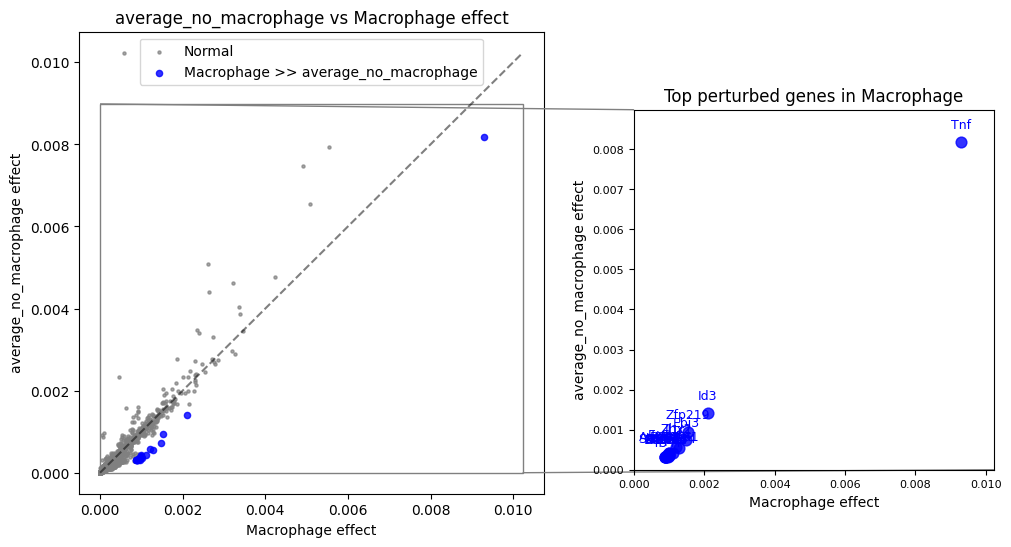
Compare macrophage response to the average of all other cell types:
(total_effect["Macrophage"] - total_effect.loc[:, ~total_effect.columns.isin(["Macrophage"])].mean(1)).sort_values(ascending=False)[:20]
gene
Tnf         0.001129
Ebi3        0.000747
Il1r1       0.000734
Id3         0.000691
Ggh         0.000684
Timp2       0.000655
Il27        0.000654
Zhx2        0.000635
Sit1        0.000621
Arhgap31    0.000620
Actr1b      0.000598
Slc25a44    0.000597
Zfp219      0.000596
Begain      0.000584
Smpd3       0.000579
Aptx        0.000579
Lipc        0.000573
Pmvk        0.000567
Mplkip      0.000567
Asb1        0.000565
dtype: float64
Note
Biological interpretation
Macrophage-specific genes include markers of innate immunity and tissue remodeling:
Tnf: Pro-inflammatory cytokine
Tgfb1: Key regulator of tissue remodeling
Mmp9: Matrix metalloproteinase involved in extracellular matrix degradation
total_effect["average_no_macrophage"] = total_effect.loc[:, ~total_effect.columns.isin(["Macrophage"])].mean(axis=1)
recon.plot.plot_celltype_comparison(total_effect, "Macrophage", "average_no_macrophage", quantile=0.998)
# delete to not include it by mistake later
del total_effect["average_no_macrophage"]
Gene Ranking Analysis
Compare Gene Ranks Across Cell Types
We can also compare the rank of each gene across different cell types to identify genes that are consistently high or show cell-type-specific rankings:
total_effect.rank().sort_values(by="NK_cell")[:10]
| celltype_target | B_cell | pDC | Macrophage | NK_cell | T_cell_CD4 | T_cell_CD8 |
|---|---|---|---|---|---|---|
| gene | ||||||
| Ms4a4d | 1.0 | 1.0 | 1.0 | 1.0 | 1.0 | 1.0 |
| Hist1h2ac | 2.0 | 2.0 | 2.0 | 2.0 | 2.0 | 2.0 |
| Ifi27l2a | 3.0 | 3.0 | 3.0 | 3.0 | 3.0 | 3.0 |
| A3galt2 | 4.0 | 4.0 | 4.0 | 4.0 | 4.0 | 4.0 |
| Hus1b | 5.0 | 6.0 | 6.0 | 5.0 | 7.0 | 5.0 |
| Kantr | 6.0 | 5.0 | 5.0 | 6.0 | 5.0 | 6.0 |
| Pcdhga6 | 9.0 | 7.0 | 7.0 | 7.0 | 6.0 | 8.0 |
| Sugp1 | 7.0 | 9.0 | 8.0 | 8.0 | 10.0 | 7.0 |
| Trim65 | 13.0 | 21.0 | 12.0 | 9.0 | 14.0 | 9.0 |
| Tarm1 | 12.0 | 11.0 | 10.0 | 10.0 | 8.0 | 11.0 |
Tip
The top-ranked genes are often generic markers and metabolism-related genes that appear in all cell types. For biological interpretation, it’s usually more informative to focus on known markers or genes of interest specific to your system.
Focus on Known Cell Type Markers
Warning
Interpretation caveat
These predictions are for one specific ligand (Copa). The results don’t represent the actual expression state of your cells - they represent the predicted response to this specific perturbation. You won’t necessarily retrieve all cell-type markers.
Let’s check how known immune cell markers rank in each cell type:
markers = pd.Series([
    "Ptprc",   # pan-leukocyte (CD45)
    "Cd3e", "Trac",              # T cells
    "Cd4", "Cd8a",               # helper vs cytotoxic T
    "Ncr1", "Klrk1",             # NK cells
    "Ms4a1", "Cd19", "Cd79a",    # B cells
    "Sdc1",                      # plasmablasts/plasma cells
    "Lyz2", "Adgre1", "Csf1r",   # monocytes/macrophages
    "Itgax", "Zbtb46",           # conventional dendritic cells
    "Siglech",                   # plasmacytoid dendritic cells
    "Ly6g", "S100a8", "S100a9"   # neutrophils
])

markers = markers[markers.isin(total_effect.index).values]

total_effect.rank(ascending=False).loc[markers].sort_values(by="NK_cell")
| celltype_target | B_cell | pDC | Macrophage | NK_cell | T_cell_CD4 | T_cell_CD8 |
|---|---|---|---|---|---|---|
| gene | ||||||
| Cd4 | 2391.0 | 274.0 | 273.0 | 53.0 | 2480.0 | 60.0 |
| Cd19 | 492.0 | 814.0 | 797.0 | 398.0 | 365.0 | 407.0 |
| S100a8 | 1304.0 | 1550.0 | 1499.0 | 641.0 | 787.0 | 639.0 |
| Csf1r | 1419.0 | 1781.0 | 586.0 | 669.0 | 725.0 | 655.0 |
| S100a9 | 1503.0 | 1587.0 | 1557.0 | 696.0 | 710.0 | 710.0 |
| Cd79a | 876.0 | 1049.0 | 1142.0 | 750.0 | 757.0 | 734.0 |
| Sdc1 | 1505.0 | 1414.0 | 1439.0 | 828.0 | 709.0 | 832.0 |
| Itgax | 1663.0 | 1948.0 | 1903.0 | 1168.0 | 1108.0 | 1095.0 |
| Ptprc | 1805.0 | 1935.0 | 1919.0 | 1826.0 | 1766.0 | 1606.0 |
| Cd3e | 3690.0 | 3482.0 | 3183.0 | 1988.0 | 1951.0 | 2100.0 |
| Klrk1 | 547.0 | 503.0 | 549.0 | 2221.0 | 2104.0 | 2156.0 |
| Lyz2 | 4595.0 | 3840.0 | 4159.0 | 5039.0 | 4668.0 | 5129.0 |
| Zbtb46 | 5398.0 | 5408.0 | 5093.0 | 5368.0 | 5522.0 | 5602.0 |
| Ms4a1 | 5631.0 | 6793.0 | 7326.0 | 5512.0 | 4492.0 | 5131.0 |
| Cd8a | 4227.0 | 6156.0 | 5033.0 | 5599.0 | 5480.0 | 4063.0 |
| Ncr1 | 7048.0 | 7893.0 | 7954.0 | 6411.0 | 6168.0 | 6597.0 |
Summary
In this tutorial, you learned how to:
Build a multilayer network integrating GRNs, cell-cell communication, and receptor-gene links
Select a molecule to simulate as a treatment based on receptor variance
Predict treatment effects using
multicell_targets()to get direct and indirect effectsCombine effects with the α parameter (default 0.8 for direct-weighted)
Compare cell-type responses to identify differential effects and cell-type-specific genes
Tip
Next steps
Tutorial 2: Explore multicellular coordination around a pathway
Tutorial 3: Visualize molecular cascades with Sankey diagrams
Tutorial 4: Generate your own GRNs with HuMMuS